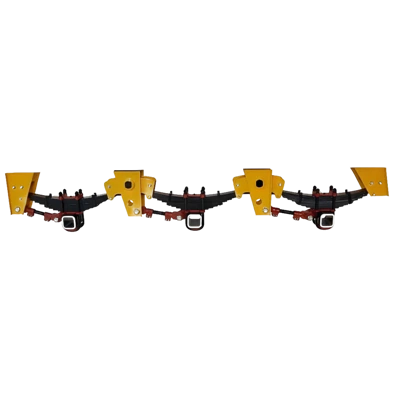
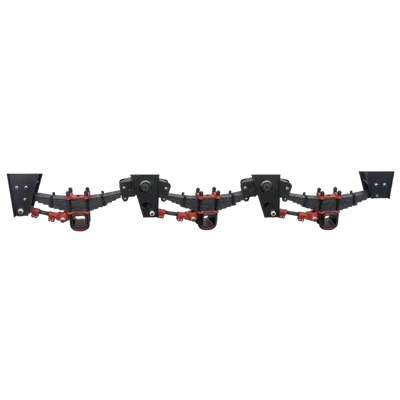
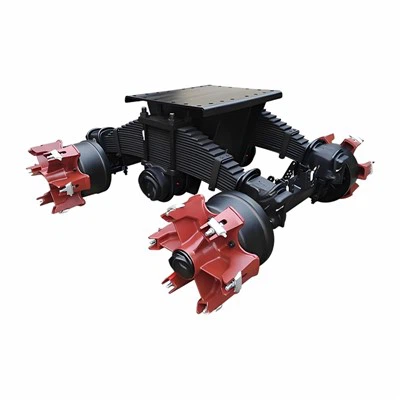
German‑style air suspension for semi‑trailers is a heavy‑duty air suspension solution originating from Germany, widely applied to large‑capacity semi‑trailers for general cargo, hazardous goods, refrigerated freight and special cargo transportation. Unlike passenger‑car air suspension, this product is developed for heavy loads, frequent start‑stop operations, long‑haul highway driving and statutory axle‑load limits. The complete system mainly consists of air springs, shock absorbers, air compressor assembly, air reservoirs, height control valves, pressure protection valves and connecting pipelines. The height control valve is the signature component of German‑style semi‑trailer air suspension, which automatically maintains a constant chassis ride height whether the trailer is empty or fully loaded, instead of supporting arbitrary active height adjustment as on passenger vehicles.
In terms of structure, the trailing‑arm type dominates German‑style semi‑trailer air suspension. The trailing arm is generally made of high‑strength steel or cast steel, and the air spring is installed between the trailing arm and the trailer frame. Compared with conventional leaf‑spring suspension, it has outstanding advantages such as lighter tare weight, better vibration isolation for fragile cargo protection, reasonable axle‑load distribution, less road damage and more stable high‑speed driving. Matched with a lift‑axle mechanism, it can raise idle axles under no‑load conditions to reduce tyre wear and fuel consumption.
Key German suppliers in this sector include SAF‑Holland, BPW, WABCO and Haldex. SAF and BPW supply integrated axle‑suspension assemblies, representing the most classic turnkey German‑style solutions for semi‑trailers, while WABCO and Haldex focus on pneumatic control valves, ECAS electronically controlled air suspension systems and other pneumatic components. Basic configurations adopt purely mechanical height control valves, and the upgraded ECAS electronically controlled air suspension enables electronic levelling, axle‑load monitoring, lift‑axle logic control and fault diagnosis, gradually becoming standard equipment on new high‑end semi‑trailers.
The upstream industrial chain covers special rubber and aramid fibre for air‑spring bellows, high‑strength castings for trailing arms, precision pneumatic valves and pressure sensors. Midstream participants are axle and suspension system integrators as well as pneumatic component manufacturers. Downstream customers include semi‑trailer OEMs, logistics fleets and special‑vehicle retrofit factories. In recent years, many domestic enterprises have launched semi‑trailer air suspension products benchmarking the classic SAF/BPW German technical route, greatly cutting procurement costs and boosting market penetration. However, gaps still exist in the long‑term durability of rubber bellows, stability of pneumatic valves and overall system matching calibration.
Major market pain points include higher upfront procurement cost than leaf‑spring suspension, ageing and air leakage of rubber bellows after long‑term operation, high maintenance difficulty and spare‑part expenses. In addition, non‑compliant low‑cost counterfeit products with insufficient load capacity and poor fatigue resistance circulate in the market, posing potential safety hazards.
Looking ahead, German‑style air suspension for semi‑trailers will develop towards lightweight design, wider ECAS application, deeper integration with ABS/EBS braking systems, longer service life of air springs, and intelligent functions such as remote fault monitoring and overload early warning. Driven by lightweight requirements, road‑protection regulations and logistics efficiency demands, the penetration rate of air suspension in the semi‑trailer market will keep increasing. For fleet operators, the core evaluation indicator for selecting air suspension products has shifted from the one‑off purchase price to comprehensive whole‑life‑cycle benefits.