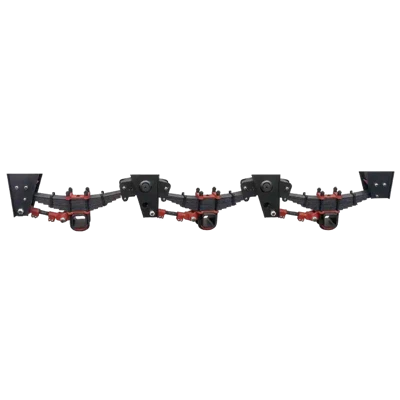
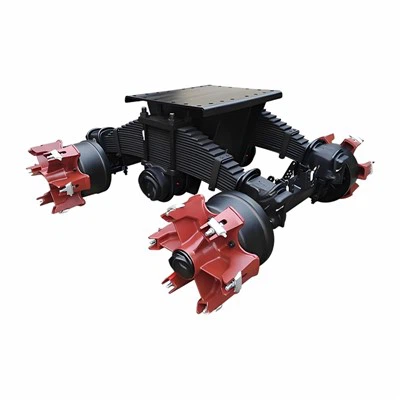
Semi-trailer chassis components serve as the foundational framework for load-bearing, steering, braking, and connection, directly determining the vehicle's load capacity, operational safety, and service life. Among these, the frame, axles, suspension, braking system, and coupling parts constitute the "vital organs" of the chassis, each undertaking irreplaceable functions.
The frame, known as the "backbone" of the semi-trailer, is typically composed of high-strength steel I-beam longitudinal beams and crossbeams. Its structural design focuses on enhancing key areas such as the gooseneck, diameter change section, and rear three-axle position to resist torsion and bending, preventing issues like frame sagging or fracture under heavy loads. With the trend of lightweighting, the penetration rate of high-strength steel (700–1200MPa) in frame manufacturing has exceeded 65%, enabling a weight reduction of 200–300kg while improving fuel efficiency by 5–7%.
Axles, which bear the load and transmit force to the wheels, are commonly available in single, tandem dual, or tri-axle configurations, tailored to meet load requirements and regulatory standards.易损件 (vulnerable parts) such as axle hubs, bearings, and brakes require regular maintenance to ensure operational reliability. The suspension system, connecting the frame and axles, plays a crucial role in absorbing shocks and stabilizing loads. Mechanical suspensions (leaf springs) are favored for their low cost and durability, while air suspensions (airbags + ECAS) offer superior comfort and height-adjustable functionality, with a penetration rate of 37.2% in high-end logistics vehicles.
In terms of technological trends, intelligence and new energy adaptation have become the core driving forces of the industry. The popularization of EBS/ESC systems and the annual 200% growth in the installation volume of drive-by-wire braking/steering systems reflect the industry's shift toward intelligence. Smart axles integrated with load, tire pressure, and vibration monitoring capabilities support predictive maintenance, significantly reducing downtime. For new energy semi-trailers, electric drive axles that integrate motors and reducers achieve a 15% weight reduction and a transmission efficiency of 94%, while battery packs require IP6K9K protection and 30g impact resistance, necessitating frame reinforcement.
The market pattern of the semi-trailer chassis parts industry is characterized by homogenization in the mid-to-low-end segment and reliance on imports or joint ventures in the high-end segment. With the continuous advancement of modularization and standardization, the interchangeability of components is improving, reducing maintenance costs. For downstream users such as logistics companies and fleet operators, selecting chassis components should adhere to the principles of matching load capacity with axle count and suspension type, adapting to road conditions, and balancing operational costs with regulatory compliance.