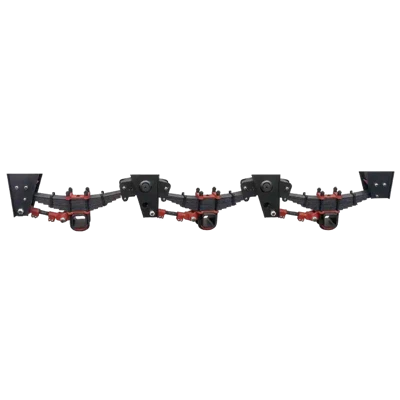
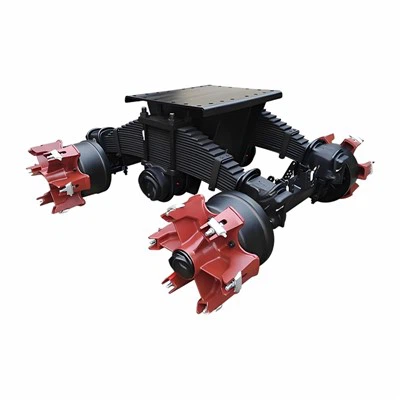
1. Definition & Working Principle
Semi-trailer air suspension is a suspension system that takes compressed air as the elastic medium. It adjusts the inflation and deflation of air springs in real time via height valves or ECAS electronic control units to maintain a constant chassis height and automatically match suspension stiffness according to load changes and road conditions.
It is mainly divided into two types:
- Mechanical Air Suspension: Controlled by pure mechanical height valves, featuring low cost and simple maintenance, suitable for medium and short-distance general cargo transportation scenarios.
- ECAS Electronically Controlled Air Suspension: Adopts CAN bus, height and pressure sensor closed-loop control, supporting automatic leveling, body lifting/lowering and axle load balance adjustment, which is the mainstream upgrading trend of the industry.
Core Working Logic: When the load increases, the body sinks and the height valve opens for air intake to lift the body; when the load decreases, the body rises and the valve exhausts air to lower the body, keeping the trailer's designed ground clearance stable in real time.
2. Core System Components
1. Air Spring (Air Bag): Double/triple convoluted rubber and cord structure, working temperature range of -40℃ to +85℃, undertaking core load-bearing and vibration damping functions.
2. Guide Arm & Thrust Rod: Transmits longitudinal and transverse force during driving, and realizes accurate positioning of the axle.
3. Shock Absorber & Stabilizer Bar: Suppresses high-frequency vibration, reduces body roll, and improves driving stability.
4. Height Control Valve & Solenoid Valve Group: Controls the inflation and deflation rhythm of the air system to ensure stable body height.
5. Air Storage Tank, Air Dryer & Air Compressor: Provides clean and dry compressed air for the whole system to avoid pipeline icing and corrosion.
6. ECU & Sensors (ECAS System): Realizes intelligent closed-loop control, data monitoring and fault diagnosis of the suspension system.
3. Core Advantages & Disadvantages (vs Leaf Spring Suspension)
Core Advantages
1. Superior Riding Smoothness: Effectively reduces cargo damage rate by more than 30%, perfectly adapting to cold chain, precision instrument and hazardous chemical transportation.
2. Extended Tire Service Life: Uniform axle load and stable tire ground contact reduce tire wear, increasing tire life by 15%-20% and cutting fuel consumption by 5%-8%.
3. Adjustable Body Height: Lower the body for convenient loading and unloading, reduce wind resistance at high speeds, and raise the chassis to improve trafficability on rough roads.
4. Lightweight Design: A complete set of air suspension is 200-400kg lighter than leaf spring suspension, increasing legal payload for fleets.
5. Road-friendly Performance: Reduces road impact damage, meeting green transportation policies and enjoying relevant highway toll preferential policies.
6. Effective Axle Protection: Avoids axle load deviation caused by partial load, prolonging the service life of axles and braking systems.
Existing Disadvantages
Higher procurement cost (about 12,000-18,000 RMB per axle); rubber seals are prone to aging; higher technical threshold for maintenance; air leakage and low-temperature failure will affect driving safety.
4. Domestic Mandatory Regulations & Policy Updates
Based on GB7258-2017 and GB38900-2024 national standards:
1. Mandatory Installation Models: All hazardous chemical transport semi-trailers, three-axle fence/storage grid semi-trailers, and heavy-duty hazardous chemical trucks with a total weight of more than 12 tons (rear axle).
2. 2026 Latest Policies:
- The air suspension assembly rate of newly declared heavy-duty semi-trailer tractors is not less than 35%.
- Long-distance trunk semi-trailers of more than 35 tons without electronically controlled air suspension will be included in key supervision with the secondary maintenance cycle shortened to 6 months.
- Annual inspection adds mandatory air tightness test: the system pressure drop shall not exceed 10% within 12 hours.
3. Industry Guidance Policy: Air suspension is listed as a recommended mandatory configuration for new energy commercial vehicle chassis.
5. 2024-2026 Market Pattern & Penetration Rate
Industry Penetration
- Overall penetration of new domestic semi-trailers: 18.7% (2024) → 32% (2025) → expected 40% (2027).
- Segmented penetration rate: 42.3% for refrigerated trailers, 23.6% for container trailers, 19.8% for hazardous chemical trailers, and 12.1% for ordinary box trailers.
- The penetration rate in European and American markets exceeds 80%, with huge replacement space in China's market.
Competitive Echelon
1. High-end Foreign Brands: SAF-Holland, BPW, Hendrickson, WABCO (ECAS electronic control system).
2. Leading Domestic Brands: CIMC, Fuwa, Wan'an, Keman, supporting mainstream heavy-duty truck manufacturers such as Sinotruk and Shaanxi Automobile; the domestic localization rate of core parts has exceeded 65%.
3. Key Component Suppliers: Continental, Goodyear (air bags); Ruili, WABCO (valve and electronic control parts).
Market Scale
The domestic commercial vehicle air suspension market size reached about 5.5 billion RMB in 2025, and is expected to break 10.5 billion RMB in 2027. The annual market demand for semi-trailer air suspension sets maintains 150,000-200,000 sets.
6. Main Product Types & Application Scenarios
1. Standard Single Air Suspension (1/2/3-axle): Widely used in fence trailers, box trailers and car carrier trailers for general cargo transportation.
2. Lift Axle Air Suspension: Equipped with axle lifting function, lifting idle axles during no-load/light-load driving to reduce fuel consumption and tire wear, which is a standard configuration for express and fast freight transportation.
3. Heavy-duty Balanced Air Suspension: Suitable for heavy-duty scenarios such as oversized cargo transportation, tank trailers and modified dump semi-trailers.
4. ECAS Intelligent Air Suspension: Mainly used for high-value scenarios such as cold chain logistics, cross-border trunk transportation and export standard trailers.
7. Standard Maintenance & Common Faults
Standard Maintenance Cycle
- Every 30,000 km: Inspect air bags, shock absorbers, pipeline joints and height control rods.
- Every 60,000 km: Replace air dryer cartridges and clean valve group assemblies.
- Annual Inspection: Complete 12-hour system pressure retention test, ECAS system calibration and bushing replacement.
Typical Common Faults
1. Aging and air leakage of air bags, resulting in trailer body tilting and chassis collapse when parked overnight.
2. Stuck height valves or faulty solenoid valves, causing unlevel body height and failed height adjustment.
3. Failure of air dryer leading to pipeline icing, valve corrosion and system air supply failure in low-temperature environments.
4. ECAS system communication faults caused by CAN line damage and sensor data drift.
8. Industry Development Trends (2026-2030)
1. Full Popularization of ECAS Intelligence: Realize automatic weighing, ramp leveling, intelligent fault early warning and fleet TCO network management.
2. Lightweight & Material Upgrading: Adopt aramid fiber air bags, aluminum alloy guide arms and integrated axle-suspension assemblies to further reduce vehicle weight.
3. Supporting New Energy Trailers: Develop integrated chassis solutions matching electric drive, air suspension and energy recovery systems.
4. Expanded Mandatory Installation Scope: More long-distance trunk transportation and urban distribution models will be included in the air suspension popularization list.
5. Booming Aftermarket: The market of stock vehicle refitting, compliant replacement and long-life standardized maintenance will grow rapidly, with the design life of mainstream products upgraded to more than 800,000 km.
9. Selection Rules & Fleet TCO Analysis
1. Compliance First: Hazardous chemical trailers and three-axle storage grid trailers must adopt factory original air suspension, and illegal refitting is prohibited.
2. Working Condition Matching: Choose ECAS electronically controlled air suspension for long-distance high-value cargo transportation, and cost-effective mechanical air suspension for short-distance shunting operations.
3. Cost Recovery Cycle: High-end air suspension can recover the increased procurement cost within 12-24 months through saving fuel consumption, reducing tire loss and avoiding cargo damage compensation.
4. After-sales Priority: Prefer brands with national after-sales service networks and modular quick-disassembly design to reduce maintenance downtime.
10. International Standards & Export Trends
Domestic semi-trailer air suspension products fully comply with European ECE R55 and American DOT industry standards. Leading domestic manufacturers such as CIMC and Fuwa have achieved batch supporting supply for European and American trailer factories. Local electronically controlled air suspension systems are gradually breaking the monopoly of foreign brands, and the export volume of medium and high-end domestic air suspension assemblies maintains rapid growth year by year.