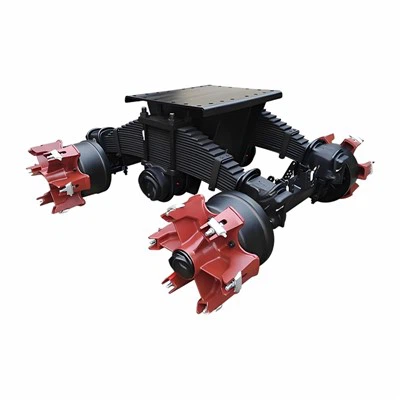
1. General Definition
Air suspension (air ride suspension) is the mainstream high-end suspension system for global long-haul logistics, cross-border transportation and specialized semi-trailers.
Instead of traditional leaf springs, it uses compressed air as the elastic medium. Equipped with height control valves, guide arms, shock absorbers and ECAS electronic control systems, it realizes automatic adjustment of chassis height, suspension stiffness and even axle load distribution.
Air suspension has become the standard configuration for cold chain, dangerous goods and high-value cargo transportation in Europe, America, Australia, Southeast Asia, the Middle East and Central Asia.
2. Global Standard Structure
All mainstream air suspension systems comply with ISO, SAE and ECE international standards with universal interchangeable spare parts worldwide.
2.1 Core Mechanical Components
Air Spring Bag
Made of multi-layer high-strength rubber cord fabric. Standard working temperature: -40℃ to 80℃. Working pressure: 0.5–1.2 MPa.
Load calculation formula: Load = Effective area × Air pressure
Certification standards: ISO 1431 aging resistance, ISO 9227 corrosion resistance, IATF16949 quality system.
Guide Arm, Shock Absorber & Track Bar
Stable structure globally. Guide arms transfer longitudinal and lateral force; shock absorbers eliminate vibration and bounce; track bars prevent axle offset to meet international vehicle stability regulations.
Lift Axle Mechanism
Widely used in global long-distance fleets. Lifting idle axles effectively reduces tire wear, rolling resistance and fuel consumption during empty return trips.
2.2 Two Global Control Systems
Mechanical Height Valve System (Basic Version)
Pure mechanical structure, low failure rate and easy maintenance. It automatically inflates and deflates according to load changes to maintain constant chassis height. Suitable for general regional transport trailers.
ECAS Electronic Air Suspension (Premium Global Standard)
Necessary configuration for European, American and cross-border TIR trailers.
Functions: independent axle leveling, one-click chassis lifting, automatic lift axle control. Fully adapted to global standard terminals, container yards and drop-and-hook operations.
Compliant with EAC, GCC and ASEAN certification requirements.
2.3 Global Air System Standard
Air pipelines follow SAE J1402 and FMVSS 121 regulations. Standard system pressure: 750–850 kPa.
Universal leakage standard: pressure drop ≤ 4 PSI within 24 hours under sealed condition.
3. Working Principle (Global Unified Logic)
1. Load changes and road vibration alter the distance between frame and axle.
2. Height valves or electronic sensors capture height deviation.
3. The system automatically inflates or deflates to balance chassis height and axle load.
4. Keep the vehicle level during full load and empty load.
5. Lower chassis height at high speed for better stability; adjustable height for standardized cargo loading and unloading.
4. Global Advantages & Disadvantages
Advantages
- Ultra Shock Absorption: Filters over 90% road vibration, zero cargo damage for precision equipment, fresh food and glass cargo.
- Light Weight & Higher Payload: 30%–50% lighter than leaf spring suspension, meeting global axle load policies for higher legal loading capacity.
- High Driving Safety: Reduces braking nosedive and corner rollover risk, compliant with ECE and FMVSS safety standards for dangerous goods transport.
- Longer Tire Service Life: Even axle load distribution avoids abnormal tire wear, lowering global fleet operating costs.
- Global Logistic Adaptability: Perfect for international multi-modal transportation, container terminals and standardized loading platforms.
Disadvantages
- Higher manufacturing and maintenance cost; average air spring service life: 5–8 years or 80,000 KM.
- Complex air pipeline structure with possible air leakage and sensor failures.
- Vulnerable to sharp rocks on unpaved roads in Africa, Central Asia and mining areas.
- Slow air leakage after long-term parking, causing chassis sinking.
5. Air Suspension VS Leaf Spring Suspension
Comparison Air Suspension Leaf Spring Suspension
Vibration Performance Excellent stable performance Hard bounce, rough empty-load driving
Legal Payload Higher global standard axle load Strict low axle load limitation
Application Scene Long-haul, cross-border, cold chain, chemical transport Short-distance construction, mining and bulk cargo
Maintenance Cost Higher precision part maintenance Simple structure, ultra durable, low cost
Tire Wear Uniform wear, long service life Severe partial wear
Global Regulation Trend Mandatory configuration for premium trailers Only for low-end short-distance vehicles
6. Global Official Regulations & Certification Standards
Europe (UNECE)
- ECE R29: Mandatory safety standard for suspension anti-failure performance.
- ECE R17: New vehicles require air suspension impact resistance and real-time pressure monitoring.
- All cross-border dangerous goods and 3-axle cold chain trailers must be equipped with air suspension.
North America (USA & Canada FMVSS)
- FMVSS 121: Unified air pressure system and leakage rate standard.
- FMVSS 126: Air suspension must cooperate with ESP stability system to prevent rollover.
- Over 98% of American long-haul trailers adopt air suspension.
Australia & New Zealand (ADR)
Comply with ADR 33/01 standard; modified air suspension requires official static load certification.
Middle East & Gulf Countries (GCC)
All 3+ axle refrigerated trailers and tank trailers must be equipped with electronic air suspension for customs clearance.
Eurasia & Central Asia (EAC)
TIR international transport trailers prioritize air suspension with low-temperature resistance design.
Southeast Asia (ASEAN)
Air suspension is legally mandatory for chemical tank trailers and refrigerated semi-trailers.
7. Global Standard Maintenance Rules
- Regularly clean rubber air springs to avoid scratch damage from stones and sharp objects.
- Avoid long-term heavy compression parking in cold regions to prevent rubber hardening and cracking.
- Check air pipes, joints and dryers periodically to eliminate slow air leakage and water accumulation.
- Replace failed shock absorbers timely to prevent continuous vehicle bouncing and air spring damage.
- Fasten loose tie rods and bushing parts regularly.
8. Common Global Faults & Symptoms
- Unbalanced chassis: Single-side air spring leakage, deformed height valve or failed shock absorber.
- Full chassis sinking: Main pipeline rupture or air reservoir pressure loss.
- Abnormal chassis height: Stuck mechanical valve or ECAS sensor malfunction.
- Continuous vehicle bouncing: Damaged shock absorber or mismatched air pressure.
9. Global Application Selection Guide
Recommended Scenarios for Air Suspension
- International TIR cross-border transportation and multi-modal transport.
- Global cold chain, hazardous chemical and high-value precision cargo fleets.
- Long-haul highway fleets in Europe, America, Australia, Middle East and Southeast Asia.
- Modern logistics enterprises pursuing standardization and low cargo damage rate.
Suitable Scenarios for Leaf Spring Suspension
- Short-distance transportation on unpaved mining and construction roads.
- Low-value bulk cargo such as coal, ore and steel.
- Low-budget short-haul local delivery fleets.
10. Industry Conclusion Worldwide
Air suspension has become the essential standard and legal threshold for global modern semi-trailer transportation.
From European ECE, American FMVSS to GCC, EAC and ASEAN standards, air suspension is rapidly replacing traditional leaf spring suspension worldwide.
It is the core configuration for high-efficiency, safe and standardized global modern logistics in the future.